Year 1937. A young Turkish naval cadet wins a State scholarship in Engineering and is sent to Germany. At the Humboldt University in Berlin he learns German and takes courses in Naval Engineering. He completes his internship at the Bremerhaven in Bremen.
In his free time he travels to Nurnberg, Koblenz, Hannover, Munchen, Dusseldorf among other cities. He takes pictures, collects postcards writes letters to family and friends .
And then the W.War II breaks out. He is called back to Turkey to attend Robert’s College, to learn English and is sent to M.I.T. in Boston in 1944. But that is another story....
THE POSTCARD OF THE RACECAR DRIVER,1938
THE POSTCARD OF THE RACE CAR DRIVER OF 1938
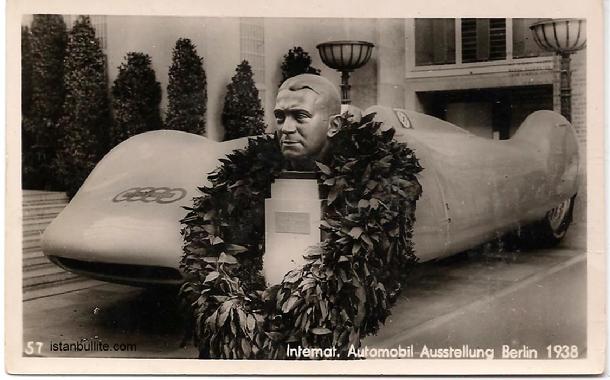
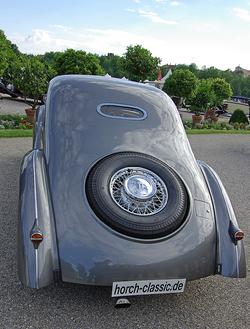
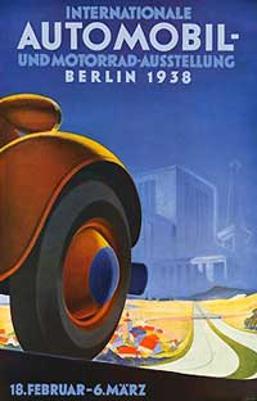
The unused post card is seventy two years old. The penciled in date in the back shows: 5/II/938. It also has a note in the back in old German Gothic font : Diese postcarte ist ein echtes photo(this postcard is an original photo). The post card has been in my Father's picture album a long time, seventy two years. Some how I recall seeing the picture when I was young child. I don't remember if I had talked to him about this picture, but I always thought the driver of the race car had died in a racing accident. Perhaps as child I had thought this was his grave. In later years , the race car looking so gray and so smooth, I thought it was a monument of the race car made out of concrete in remembrance of the driver. In the front part of the postcard, just below the picture it says: Internat.Automobil_Ausstellung Berlin 1938. (International Automobile Show ).
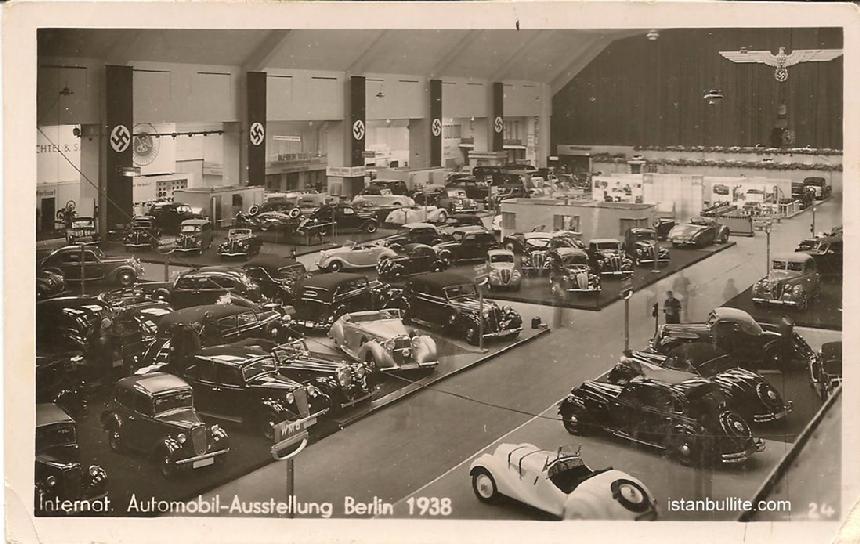
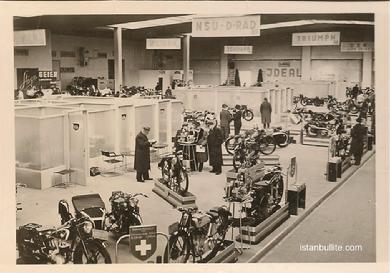
The sentence above will hold the clue to the person who's bust is seen in front of the race car in the picture. I have two more post cards from the same auto show in the album, one with cars and one with motor cycles and curious men with hats and overcoats checking out the new machines. Obviously my father had visited the the automobile and motor bike show on Feb 5, 1938 and bought these three postcards as a souvenir reflecting what he had witnessed on that day and what he wanted to share with others later.
I am not somebody who is into motor sports so much , I know very little about car racing, race car drivers and race cars.Therefore I started researching the era just before World War II for famous drivers and race cars. I came up with some information about Hitler's automobile shows which he himself opened between 1933 and 1938, the competition between Mercedes Benz and the Auto Union*, to win Grand Prix races, to break the world record in speed with their respective models. Quite a few names of the famous drivers of the time emerged from my research: Hans Stuck , Achille Varzi, Bernd Rosemeyer, Neubauer, Carraccialo and Tazzio Nuvalari.
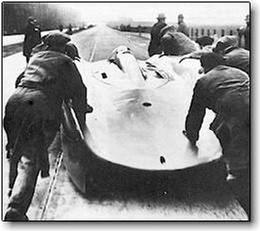
Then I looked at the picture again, this time very carefully and with a magnifier in my hand. It is a real race car, not just a fake replica or concrete monument. You can see the left rear tire coming out of the aero dynamic body. In front of the car there is the famous AUDI emblem, or the emblem of the Auto Union. On top of the sleek cockpit there is the Nazi swastika.
The only driver who was killed in a car accident among the names I found points out to the legendary Bernd Rosemeyer ? But how can I be positive that the bust in front of the car represents him, since the other Union drivers had driven this sleek race car too?
There is a plaque on the base of the bust, apparently with driver's name engraved on it. I tried to edit the picture in Picasa and zoom on the writing with no luck, it is too light. I change the contrast, change the color, can't read anything. This time with my glasses on I go to the window to the sun shine, with the magnifier I focus on the script. The first name is five letters but it is too light to read. The last name; It is in old German Gothic cursive script ,thanks to my Deutsch and education at Sankt George** I can read it : Rosemeyer . Bingo!!! That is Bernd Rosemeyer.
Now I can write his story with the information I had gathered.
THE STORY OF BERND ROSEMEYER.
THE STORY OF BERND ROSEMEYER
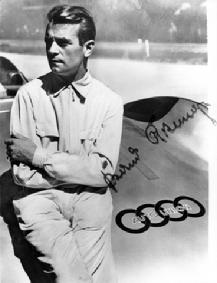
BERND ROSEMEYER
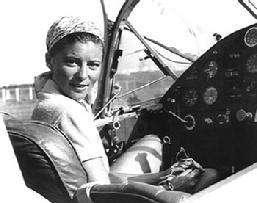
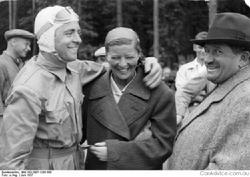
ELLY BEINHORN
Bernd Rosemeyer was born on October 14,1909 in Lingen, Lower Saxony, Germany. His father owned a garage and repair shop where young Bernd’s interest in motor bikes first started. As a young men in his early twenties he started racing motorcycles in dirt roads and on grass hills and became well known as a fearless bike driver who was known for his quickness and acrobatic crowd pleasing tricks.
In 1932 as an inexperienced driver he signed at NSU to drive four wheelers and shortly after he caught the attention of DKW where he met the Director of the Horsch factory , the famous Ferdinand Porche. Ferdinand Porche was building a revolutionary 16 cylinder engine race car, where the engine was placed in the rear, had independent suspension systems and a sleek aerodynamic body. This was the ultimate race car build to win Grand Prix races, and DKW who recently joined forces with the Auto Group was aiming to beat Mercedes Benz. The driver for this new race car was a famous Austrian named Hans Stuck who was winning one Grand Prix after another at the time.
Bernd Rosemeyer, though inexperienced , but with the heart of a lion, wanted to drive this new machine. He made numerous pleas to his bosses until they finally gave in. The trial was set at the Nurburgring course where he had driven motor bikes before. After few laps, Rosemeyer was able to control the beast and started challenging the time Hans Stuck had set previously. Rosemeyer’s impressive showing that day earned him a position as reserve driver at the Auto Union.
-Rosemeyer’s “no fear” attitude was scaring the Auto Union. They were concerned about his inexperience and his life in Grand Prix races. After warning him about the dangers he was finally granted the chance at the Avus Grand Prix in Berlin. The young driver made the best out of the race with a third place finish and with a broken engine.
The impressive showing at Avus, won Rosemeyer the fourth driver position of Auto Union in the Eiffelrennen at Nurburgring. They were to attack the Mercedes drivers and show the spectators AutoUnions supremacy with their new race car nick named the “ Silver Arrow”. When his other team mates fell behind in the race, Brend made the attack. He powered and passed Chiron and Fagioli and closed on the Mercedes’s star driver Caracciola. Carraciola the legend of Germany and Mercedes Benz felt the wind behind him. Rosemeyer kept pushing the pedal and all of a sudden he was ahead of Caricciola.
He must have said ;“İch habe Cari überholen* ”, when Cariccialo gave everything he had with a last ditch effort and took back the lead and reached the “Ziel”*. Rosemeyer, the rookie had placed second after the legend with only 1.8 seconds behind in the Eifellrennen.
On his next race ,this time he was going race against the “Great Italian”, Tazio Nuvolari. During an attempt to challenge Nuvolari his car hit a corner of the road , went into a ditch and miraculously emerged back to the road threading through a very narrow gap between a pole and a bridge. The distance between the two barricades was only little over an inch wider than the Silver Arrow at it’s widest point. The fearless Rosemeyer would finish the race in the second place after Auto Union’s Varzi. This was the last time he was going to finish a race in second place.
From 1936 to 1938 he was going to win all Grand Prix races. The first Grand Prix win came at Masarayk, then in Brno, topped with Grand Prix of Germany in Pescara, Switzerland and Italy. Winning the grand slam earned him the European Champion title. After the one of these races he was going to meet his future wife. Elly Beinhorn, was a celebrity aviatrix, only the second woman pilot to fly solo from Europe to Australia. She was an attractive blond young lady, with blue eyes. She was invited to the Czechoslavakian Grand Prix in Brno by the Auto Union where she was introduced to the winner of the Grand Prix, Bernd Rosemeyer. They danced together that night at the reception party and fell in love with each other. Nine month later they got married .
ELLY AND BERND
CELEBRITY COUPLE WITH FERDINAND PORCHE
The celebrity couple tried to distance themselves from the Nazi alignments, but the regime
trying to prove the German supremacy, exploited their fame like they did with so many other
athletes .They were considered the ultimate Aryan couple and Bernd was appointed Haupt
Stürmführer* in the SS organization, a rank he did not care for, but was not able to refuse. On
the other hand Elly the celebrity pilot was travelling all over Germany and giving lectures about
flights and airplanes to the German youth.
In the mean time, according to the British sports cars historian Cyril Posthumas, “ Rosemeyer
shot meteor like across motor racing firmament” and one of his biggest victories was still
to come. At the Eifellrennen, a favorite course he was very familiar with, he was going to
beat Caracciola and Nuvolari on a foggy day with almost no visibility. After the victory in
Nurburgring the celebrity couple were going to fly to the United States and he was going
to win the Vanderbilt cup and also the hearts of American fans.
Rosemeyer was now on top of the mountain. He had won all kinds of Grand Prix races in two
continents, had broken all land speed records, was happily married and her beloved wife
had given him a son in November of 1937. But as Posthumas said,” his three short shattering
seasons of driving” was coming to end and “his light was going out” all of sudden. Hitler’s
Automobillle Austellung was scheduled in February and the Mercedes Benz having their records
surpassed by the Auto Union, were eager to try taking their speed record back before the car
show started.
The speed record attempt by the two automakers was scheduled on January 28, 1938 on the
Frankfurt-Darmstadt Autobahn. At 8:00 A.M. Caracciola was going first on the Autbahn. To his
advantage the gusty winds had not started yet and the Mercedes pilot broke the record with
268 mph. It was almost noon when the winds started picking up when Rosemeyer jumped into
the cockpit and his crewman closed the top on him. When his Auto Union streamliner reached
270 miles an hour on the autobahn the cross winds were also at their maximum speed. Effected
by the gusty wind the cars rear left tire went off the concrete and touched the median grass.
Rosemeyer tried to rail the car back in to the autobahn. It wasn’t meant to be, the car skidded
of the highway, was air born and landed by the trees and bushes on the side of the road. The
fearless driver was thrown out of the car. His life, like a candle in the wind ,had ended right
there. People who saw him on the grass said he had no fear of sign on his face but rather an
expression of satisfaction.
Elly wanted to be with her husband for this speed record attempt, but a sold out scheduled
lecture in Frankfurt had denied her that wish. As she would write in her biography in later
years , “she did not make on time from Frankfurt. Their son at the time was only ten weeks old.
Bernd Rosemeyer was buried with military honours against the wishes of his wife. Some say,
when the Nazi Officials started making speeches at the open grave side, she left the scene
quietly.
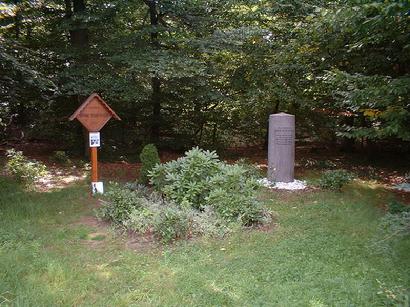
Today by the Autobahn where Rosemeyer died seventy two years ago there is a small rest area and a memorial for him. Elly Beinhorn remarried four years later and she lived to be
hundred years old. And during all these sixty nine years before she died in2007, she would
place thirteen* flowers on his grave on January 28, on the anniversary of his death.
Cem Özmeral
January 20,2011
Dublin, Ohio
*Haupt Stürm Führer : Head Storm Driver
* überholen: to pass (a car)
*ziel: target
*13 . Rosemeyer's lucky number. He won several races on the thirteenth, married to Elly Beinhorn on the thirteenth.
START OF SPEED RECORD ATTEMPT
THE START OF THE LAST DAY
References:
*Wikipedia
Auto Union was an amalgamation of four German automobile manufacturers, founded in 1932 and established in 1936 in Chemnitz, Saxony, during the Great Depression. The company has evolved into present day Audi, as a subsidiary of Volkswagen Group.
Auto Union is widely known for its racing team (Auto Union Rennabteilung, based at Horch works in Zwickau/Saxony). The Silver Arrows of these two German teams (Mercedes Benz and Auto Union) dominated not only GP car racing from 1934 onwards, but set records that would take decades to beat. For example, the power levels of the unlimited 1937 models were only equalled in the early 1980s by turbocharged Formula One Grand Prix cars.
www.chromjuwellen.com 100 Roses for Rosemeyer
autosports.com ThirteenFlowers, The story of Bernd and Elley Rosemeyer
www.ddavid.com/formula1/rose_bio.htm
http://en.wikipedia.org/wiki/Elly_Beinhorn
http://www.kolumbus.fi/leif.snellman/zana.htm A road map for atentative explanation of Bernd Rosemeyer's January 28,1938 accident
http://en.wikipedia.org/wiki/Bernd_Rosemeyer
A note and two photos from the Archives of K.-J. Roßfeldt
As regards your story on Bernd Rosemeyer. It is correct that he died in a speed-record-duel when he crashed his Auto-Union streamlined record car (Mercedes-Benz with their driver Carracciola had been the second party in that contest however had finished earlier - and thus before the wind came up which 'lifted' Rosemeyer's car from the road).
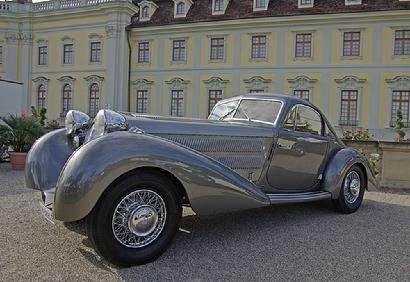
My search for a photo of the Rolls-Royce Phantom III bodied by Erdmann & Rossi hence will go on. Should you ever be interested to learn what the private motor car of the late Bernd Rosemeyer did look like: The attached photos will tell you. He ordered his personal transport - which he nicknamed 'Manuela' (his wife's name 'Elly' is an abbreviation of 'Manuela) - to be bodied by Erdmann & Rossi as a fastback 2-Door-Fixed Head Coupé. A few year ago a tremendous amount had been invested to re-create that coachwork on a Horch chassis-cum-engine from the 30ies.
Thank you very much again for your kind help which I consider as an example there is truth in the idiom "Türk - Alman - Cadesi".
With kind regards Klaus-Josef Rossfeldt
1938 BERLIN AUTOMOBILE SHOW AND THE KdF WAGEN
“….dear Mother there are only very few days here with sun shine. Today was one of those rare sunny days. First we went to the so called Reich’s Sport field where the World Olympics took place and saw the swimming pools. It is a gorgeous place; with beautiful pools surrounded by emerald green grass fields. Then we went to the International Automobile Showplace where we saw the newest German automobiles like Mercedes Benz, the Auto Union and a new little automobile called the kdf Wagen *................”
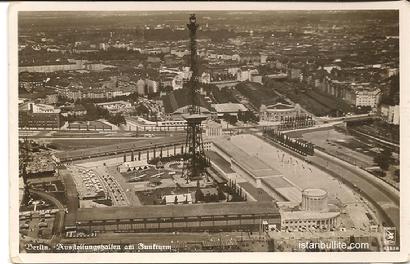
So says the post card dated February 5, 1938 which my Father, the young Turkish Naval Cadet had sent to her mother in Turkey. One of the postcards from that day shows the the so called Ausstellungshalle in Berlin, the second inside the show room with the newest German cars and the Nazi swastika emblem on columns surrounding the show room and finally on the third postcard the motorcycles being showcased to men with overcoats and hats.
All three postcards seemed like they had a story to tell, so I started looking for some answers. Where was the Ausstellungs Halle in Berlin in 1938, was this the first Automobile show of the Hitler era, and what was the KdF Wagen ? Following are some of the answers I came up with:
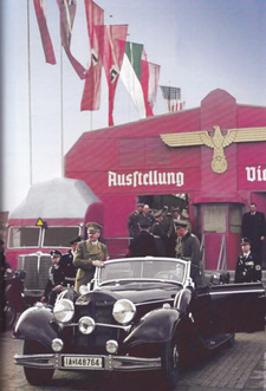
The Ausstellungshalle or the Exhibition Hall was located by the famous Berliner Funkturm ( Radio Tower) in Berlin. Hitler had opened the automobile shows here, usually in the month of February every year from 1933to 1938, in the same location. He gave the opening speech on February 20, 1938 at the exhibition. Two weeks later my father had visited the showroom and purchased the postcards from the Ausstellungshalle. One of the postcards he bought that day was about the race car driver Bernd Rosemeyer, covered by our previous story.
Hitler opened the Auto exhibition on February 17, 1939 for a last time but this time in a different location at Messehallen.
Allthough it is not on the postcard, one of the cars exhibited at the show was the so called KdF Wagen. Apparently this was one of the main attractions of the 1938 Auto show in Berlin. Hitler’s idea was that every German was to enjoy the comfort, speed and power of a small inexpensive automobile. It was later called the Volkswagen.
I remember when I was a young child in Turkey people would pronounce the car as “voswagen” or use the nickname “vosvos”. When I came to the the United States in my mid twenties , my wife was pronouncing her little red beetle as VOLKSwagen. My father would always correct it :“Folkswagen”, Folkswagen, it means people’s car, in German. The “V” is pronounced as “F”.
And who was the designer of this car and what did KdF Wagen mean? The following website : www.strangevehicles.greyfalcon.us shed light on these questions:
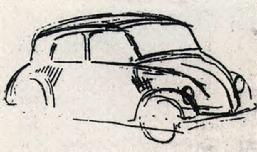
"Sitting at a restaurant table in Munich in the summer of 1932, Hitler designed the prototype for what would become the immensely successful Beetle design for Volkswagen (literally, the "car of the people").
In an era where only the most economic elite possessed cars, Hitler believed that all people should be able to own a car and additionally thought that a smart design could allow for reliability, enjoyment, and vacation travel. The name given to the car in 1938 was Kraft durch Freude (KdF-Wagen, literally "strength through joy car").
Hitler gave his design to the head of Daimler-Benz, Jakob Werlin, and stressed its importance. "Take it with you and speak with people who understand more about it than I do. But don't forget it. I want to hear from you soon, about the technical details."
HITLER BY THE AUSSTELLUNGSHALLE,FEB 7, 1937
HITLER'S PERSONAL SKETCH OF KdF
References:
http://www.hitlerpages.com
www.strangevehicles.greyfalcon.us
*picture: Reichshauptstadt Berlin, 2009)
NÜRNBERG ZEPPELIN FIELD 1938
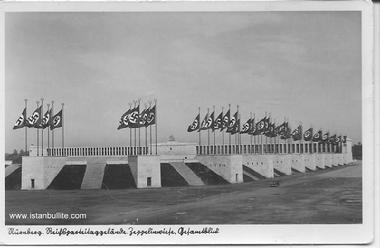
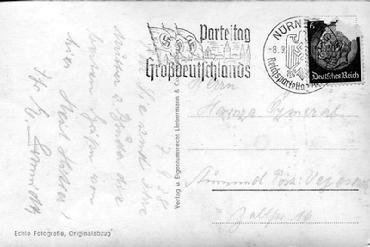
The postcard was addressed to Herr Hamza Ozmeral. The date it was written was 7.9.1938. It was postmarked the next day with a six pfennig Bismarck postage stamp. The stamp next to the postage with the Nazi flags had to be for the special occasion: Congress day of the Great Germany. The post card was mailed from Nürnberg.
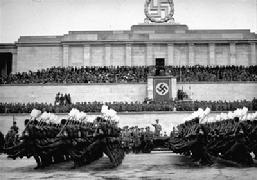
In the contents part: Best wishes is sent to the addressee, his mother and his brother. The postcard was signed by Frau (or Fraulein) E. Schmidt preceding a "Heil Hitler" salute. Who was this Mrs.(or Ms.) Schmidt ? We don't know. And how about the picture on the postcard with the Nazi flags surrounding the place which resembles a sports arena or stadium ? On the bottom of the picture with a Gothic font it says: Nürnberg Reichsparteitaggelande. Zeppellinfeld. Gesamtblick. In other words: Nürnberg Reich's party congress grounds.Zeppelinfield. General view.
Zeppellinfield? For what purpose was it used for? Does it still exist today? How did the inside of the arena look like? These were the first questions which came to my mind when I first saw the post card. And here is what I found out:
The Reich party grounds were build in 1933 on a eleven kilometer square field and served as the deployment and marching grounds of the Nazi soldiers until 1938. It consisted of several buildings and halls, a main road called the Grosse Strasse, a never realized biggest stadium of the world, and two deployment and marching fields, one of which called the Zeppellin Field.
Four days after the American seventh army captured the city of Nurenberg they marched to the Zeppellinfield and blew up the Nazi swastika emblem which was encircled by a gold laurel wreath. The date coincided with Hitler's fifty sixth birthday; April 20, 1945.
Here is what we found at the Wikepedia about the Zeppelin Field's life after 1945:
The Zeppelin Field (in German: Zeppelinfeld) is located east of the Great Road. It consi(Zeppelinhaupttribüne) with a width of 360 meters (400 yards) and a smaller stand. It was one of Albert Speer's first works for the sts of a large grandstandNazi party and was based upon the Pergamon Altar. The grandstand is famous as the building that had the swastika blown from atop it in 1945, after Germany's fall in World War II.
From 1947 to 1995 the Nurnberg American High School, a DoDDS facility, used the field (called 'Soldiers Field') for high school football and soccer. In the 1970s, the pillars were removed for safety reasons. Years of neglect had taken their toll. The rest of the stand is intact and used as the centerpiece of the Norisring motor racing track. The German leg of the traveling heavy metal festival Monsters of Rock was held here twice during the 1980s.
SOLDIERS MARCHING IN FRONT OF HITLER
MUSEUM OF FASCINATION UND GEWALT
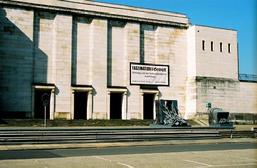
And today where once the main entrance of the Zeppellinfeld stood at the Golden Hall , there is a museum called "Fascination und Gewalt"(Violence). While on the big screen Hitler's soldiers are marching on the Zeppellin Field, the columns in the building are showing the concentration camp victims in contrast.
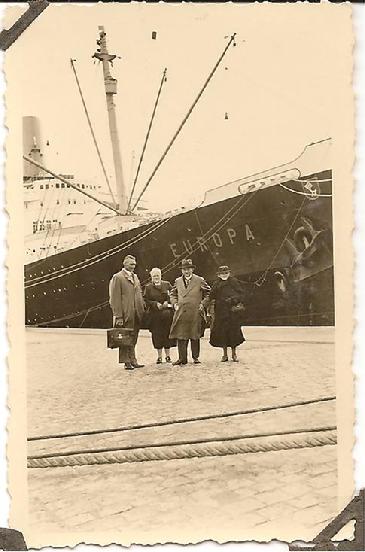
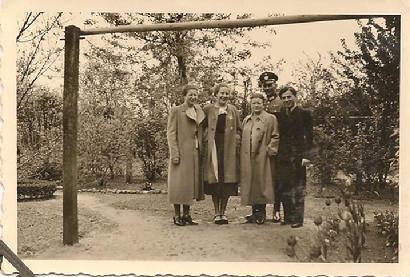
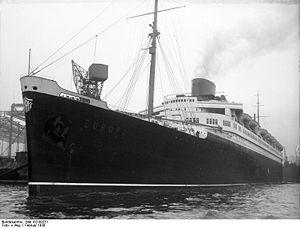
“Today we toured the Bremerhaven with my landlords and their friends. I took their picture with my camera* in front of SS Europa, sister ship off SS Bremen. Both of these ships are the largest ocean liners of Germany. 13.VI .1937.”
So says the faded line on the back of an old photograph. At that time my father was a young Naval cadet who was doing his internship in Bremen in a shipyard and was staying with a German family.While he was there, Germany was slowly being Hitlerized and the Nazis were taken charge. “Heil Hitler” was the expected salute of the times. My father had told us that he would often, replace Hitler's name with Ataturk, explaining to his German friends that he was a Turk not a German.
KOBLENZ 1938
Above are two more photos from 1938. The first one shows him on the deck of a river cruiser in Koblenz; notice the Nazi Flag in the background . The second picture was taken in the garden of the house he was staying in Bremen. The Land lady’s brother was a Nazi Officer in the German Army.
But what interested me more was the first picture of the cruise liner SS Europa. When was the ship build, how long did she serve, did she survive the Second World War, which was to start a year after the picture was taken? These were the questions , I had to find an answer for. And here is what I found out:
When Germany lost the First World War in 1918, the Allied Forces had dismantled the German fleet. All commercial and military German ships were taken by the victors of the war.In 1929 more than ten years after the war ended, Germany was able to build two new Ocean liners, technologically the most advanced and fastest ships of their times: Bremen and Europa. The sister ships started several transatlantic journeys which only took a mere four and half days one way.
With Hitler’s rise to power Bremen and Europa were not only seen as steam ships as the abbreviation SS in front of their names suggested, but were also suspected to be the Nazi Guards; Schutz Staffel, the name for Hitler’s paramilitary organization, which was also abbreviated as SS. Every room in Europa is said to have a copy of “Mein Kampf” and both ships were thought to be armed with weapons. Because of this fear, British liners like Queen Marry often changed their routes not to cross the German liners and if they did cross each other, both parties often omitted the customary ocean salute of three horns.
When the second World War broke in 1939, Bremen narrowly escaped British war ships who were docked out side of the New York harbour and immediately returned to Bremerhaven. There she was burned and destroyed by the Anti -Nazi Germans. The Europa on the other hand survived the whole war and was captured in 1939 by the Allied forces in Bremerhaven, where her sister Bremen had ceased her existence and where eight years earlier the young Turkish intern had taken her picture.
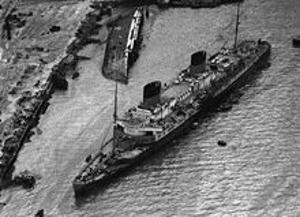
After the war, Europa was first used to bring American troops home and later awarded to France as a reparation for the loss of Normandie. There in the porte of Le Havre she collided with the capsized Paris and sunk. The French raised the ship, restored her and gave her a face lift and a new name: Liberte. She served as a French liner until 1958 and retired at Port Le Havre and docked by the new French Ocean Liner France. In the early nineteen sixtyees some thirty years after she sailed for her maiden journey in Bremerhaven, she was towed to another foreign country, Italy. There she was scraped of here existence and her metal.
BREMEN AND EUR0PA IN BREMERHAVEN 1930
Original historic description:
Deutschlands größte Schiffe "Europa" und "Bremen" - am Pier des Norddeutschen Lloyds in Bremerhaven vom Flugzeug aus gesehen. Vorn die "Europa", welche am 19. März ihre Jungfernreise antreten wird, dahinter die "Bremen".
(Germany's biggest ships "Europa" and "Bremen as seen from an airplane at the North-German Lloyds in Bremerhaven .In front is "Europa" who is scheduled for her maiden voyage on March 19 and behind her is Bremen) C.Ö.
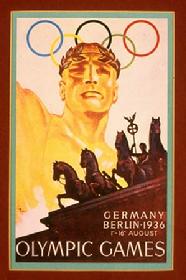
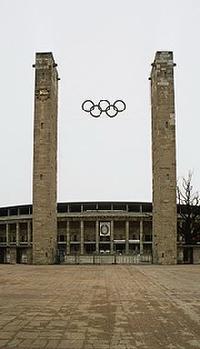
The 1936 Berlin Olympics were opened by Adolf Hitler on August 1, 1936 in the Olympiastadion . The Olympic torch was brought from Olympia Greece after a 3000 km journey which had changed hands by hundreds of athletes in six different countries. About four thousand athletes attend the games and it was the first Olympics with television coverage ; big screen TVs were scattered all over Berlin. The Nazi regime of the Third Reich tried to manipulate the games and prove the world the German supremacy but an African American athlete from the United States spoiled Hitler’s desire. Jesse Owens won a record four gold medals and Hitler had to exit the Olympiastadion in a hurry, to avoid shaking hands with the Gold medalist American athletes of the 4x100 meter rally.
Reichssportfeld
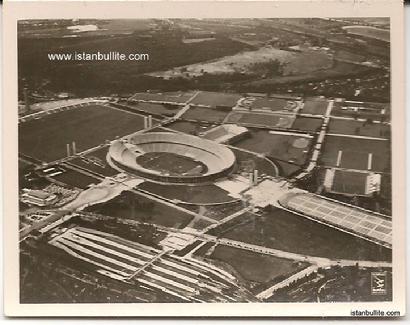
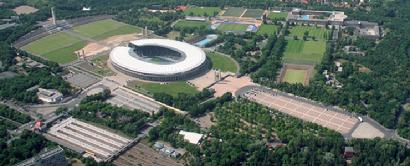
One of the several postcards of my father's collection shows the Reichssport field, the huge sports arena where the 1936 Olympics took place. A year after the Olympics he was writing to his mother and telling her how impressive the swimming pools were. "Mother, you should see the women who are even older than you are, playing and swimming in these pools."
Wikipedia gives the following information about the Reichssportfeld of 1936 Berlin Olympics:
Reichssportfeld
In 1931, the International Olympic Committee made Berlin the host city of the 11th Summer Olympics.
Originally, the German government decided merely to restore the earlier Olympiastadion (German Stadium) of 1916, with Werner March again retained to do this.
When the Nazis came to power in Germany (1933), they decided to use the Olympic Games for propaganda purposes. With these plans in mind, Hitler ordered the construction of a great sports complex in Grunewald named the "Reichssportfeld" with a totally new Olympiastadion. Architect Werner March remained in charge of the project, assisted by his brother Walter March.
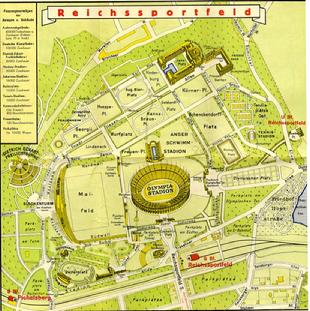
Construction took place from 1934 to 1936. When the Reichssportfeld was finished, it was 1.32 square kilometres (326 acres). It consisted of (east to west): the Olympiastadion, the Maifeld (Mayfield) (capacity of 50,000) and the Waldbühne amphitheater (capacity of 25,000), in addition to various places, buildings and facilities for different sports (such as football/soccer, swimming, equestrian events, and field hockey) in the northern part.
[edit]Olympiastadion
Werner March built the new Olympiastadion on the foundation of the original Deutsches Stadion, once again with the lower half of the structure buried 12 meters underground.
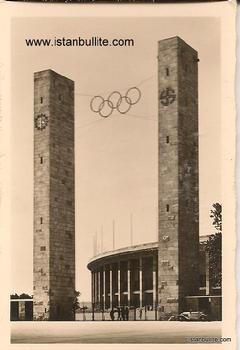
The capacity of the Olympiastadion reached 110,000 spectators. It also possessed a special stand for Adolf Hitler and his political associates. At its end, aligned with the symmetrically-designed layout of the buildings of the Olympischer Platz and toward the Maifeld, was the Marathon Gate with a big receptacle for the Olympic Flame.
To the east of the stadium, there were two field hockey stadiums that hosted the competitions that were won by India.
[edit]Maifeld
Maifeld (Mayfield) was created as a huge lawn (112,000 square metres, 28 acres) for gymnastic demonstrations, specifically annual May Day celebrations by Hitler's government.
Maifeld was surrounded by 19 metres of land elevation (62 ft), even though the Olympiastadion (to the east) was only 17 metres (55 ft) high.
The total capacity was 250,000 people, with 60,000 in the large stands that extended at the west end. Also located there were the Langemarck-Halle (below) and the Bell Tower (rising high).
The walls were built with sturdy stone from the area of the Lower Alps, and also feature equine sculptures (work of Josef Wackerle).
During the 1936 Olympics, the Maifeld was used for polo and equestrian dressage events.
REICHSSPORTFELD 1936
SPORTSFIELD TODAY
CLICK TO ENLARGE REICHSSPORTFELD
Osttor des Stadions/Eastern Gate of the Stadium REICHS SPORTFIELD
EAST GATE 1936
EAST GATE TODAY
Olympisches Dorf /Olympic Village and Jesse Owens
For me, a nine year old boy at the time, the 1956 Olympics in Melbourne, Australia was the first time I had developed an interest in Olympics. The success of the Turkish wrestlers in Melbourne and their supreme performance which had earned them seven gold medals during the Olympics in Rome in 1960, made me an immediate fan of the games. I started collecting stamps, reading books and getting to know gold medalist like Pauva Nurmi “the Flying Finns”, Emil Zatopek , “the Czech Locomotive” : the only Olympians of the pre- World War II era, with three gold medals each.
But soon I found out that no other athlete’s fame had come close to Jesse Owens, the black American athlete who had vanquished Hitler’s claim of the Aryan race’s supremacy, with four gold medals in the 1936 Olympics in Berlin. Germany topped the medal count in Berlin, but Owens was the only athlete with four gold medals: 100m, 200m, long jump and 4x100 relay and he was not from the the so called “supreme race”. In the United States he was not allowed to travel and stay in the same hotels as the white athletes. During the Berlin Olympics he had enjoyed staying in the Olympic village with the other the American athletes and while Hitler had publicly recognized Owen’s achievements, it is said that President Franklin D. Roosevelt failed to send him a congratulatory telegram. What was news to me in later years was that Jesse Owens, the “Buckeye Bullet” had attended Ohio State University and since he was black, he was not allowed a scholarship and had to support his education with part time jobs.
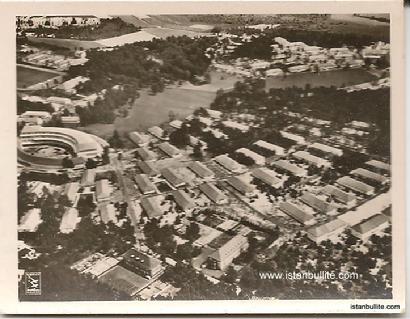
In 1937 my father had bought postcards of the Reichssportfield were Jesse competed in front of 110 000 fans and the Olympische Dorf were he had stayed a year ago. In 2011, I am living in the same city where Jesse Owens went to College once and attended track meets in the Ohio State University Campus. The Buckeye’s famous stadium the “Horse Shoe” with its 105 000 capacity, has been the stage to many famous football players, coaches and athletes over the years, but undoubtedly none was as big as Jesse Owens.
1936 POSTCARD OF THE OLYMPIC VILLAGE
Image:
Web Pictures:
Wikipedia, CommonsL Olympischer Dorf(Berlin)- Sammlung von Bildern, Videos und Audio dateien Offizielle Website des Historischen olympischen Dorfes von 1936-Historie, Kontakt, Veranstaltungen Ehemaliges olympisches Dorf Dalgow Elstal--Sehr viele Bilder und Informatinanen zum olypmischen Dorf von 1936 auf gesichtsspuren .de(vormals lostplaces.de)Autogrammerjager im Geisterdorf- Feature einestages-Spiegel Online 3. April 2009
www.zeit/de/online Das fast fergessene Dorf , Susanne Gough
Deutschland Halle
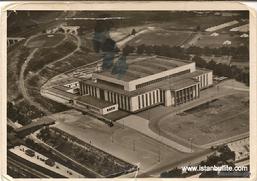
One of the many postcards, I found one picturing the ”Deutschland Halle”, my Father had sent to her mother in Istanbul as a holiday greeting (Şeker bayramı), postmarked on December 6, 1937.
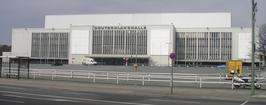
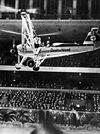
I looked up the “Deutschland Halle” and found out that it was build for the 1936 Olympics in less than eight months and was inaugurated by Hitler in 1935. During the Olympics it was use for indoor sports events, like boxing, wrestling and weightlifting. After the Olympics and before the war it was used as a Nazi rallying arena and showplace for the German Wehrmacht* . One of such shows was the first inside helicopter show by the Nazi pilot Hanna Reitch in 1938. During the 1943 British air raids, the Deutschland Halle was heavily destroyed and remained closed until 1957 when it was reopened as a venue for concerts by famous artists and music groups as well as for sporting events. Some of the famous guests who performed here were: Ella Fitzgerald, the Rolling Stones, Jimmy Hendrix and Muhammed Ali.
Over the years the arena became unstable and dangerous because of it’s old roof and closed to public in 1997. In 2008 the Berlin senate decided to demolish the building but not before the year 2011, the year in which we are writing these short articles.
DEUTSCHLANDHALLE 1936
Deutschland Halle today
Hanna Reitch's show in 1938
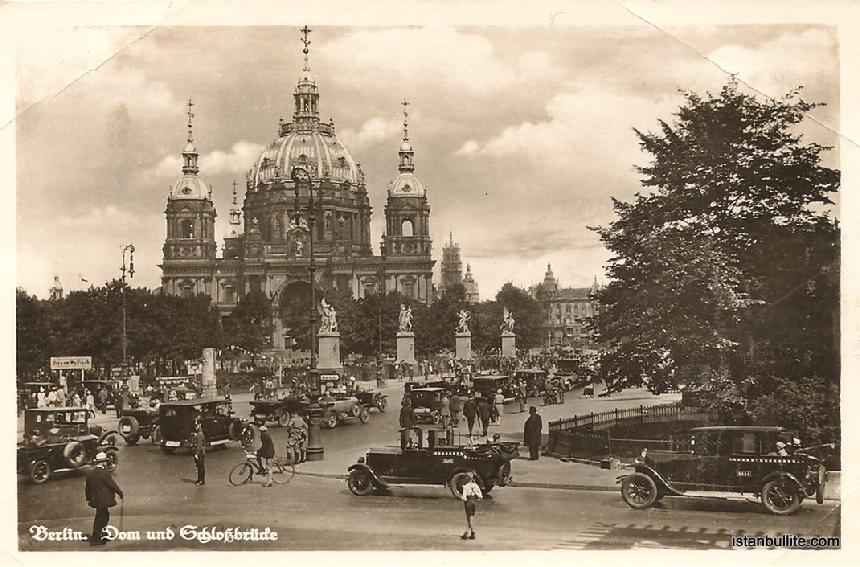
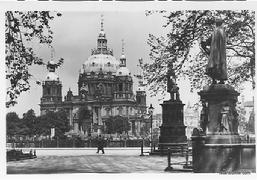
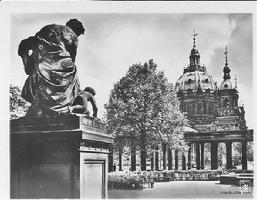
BERLINER DOM UND SCHLOSSGARTEN
.......Today we spent some time at the Fredrick's Strasse and ended up in Schlotz Platz or the Palace Grounds. There is a huge Palace here, hundreds of years old surrounded by several magnificent monuments.............
(Translated from his Postcard to his mother and brother dated February 27, 1938 )
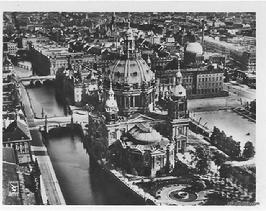
The Berliner Dom is a baroque Cathedral built between 1894 and 1905. It is located on an island in the river Spree, also known as the Museum Island. The current building is the third church built at this location.
The first Protestant Cathedral was build here in 1750 as the Court church of the Hochenzollern dynasty replacing the existing Dominican church. It was remodeled by Architect Karl Friedrich Schinkel. In 1894 following Emperor Wilhelm II's orders the building was demolished and a new Baroque style Cathedral erected in it's place by Julius Raschdorf. The building was heavily damaged during the second World War and reconstruction of the Church was delayed until 1975. It's interior was rebuild between 1984 and 1993 and finally in 1996 the new Cathedral with it's simplified form was inaugurated.
"BERLINER DOM" TODAY
References:
http://www.aviewoncities.com/berlin/dom.htm
Berlin, Master Piece of Architecture, Andras Kaldor,Woodbridge, Suffolk, 2002.